

Change Mentor

Clarity
Unique Value
I help leaders, entrepreneurs and organisations
see more clearly, make better decisions,and build ways of working where human experience, strategic thinking and AI truly come together.
I help when every decision lands on your desk, when the team is working but not in the same direction, or when you're already using AI but haven't yet built it into a real operating system. The goal: a structure that is at once authentic, sustainable and results-driven.
This page is relevant if you have a lot of decisions to make, the operational load is high, and it's becoming increasingly important to figure out what actually moves things forward – and what's no longer worth carrying.

Common situations where it's worth rethinking how you operate
The real question is rarely what else could be done. It's where the time, energy and attention are being lost. These three situations speak to those for whom this is no longer a theory – it's daily experience.
When every decision lands with the leader
There are countless decisions to make each day, but no clear sense of what the real priority is. Time gets consumed by the urgent, while the important keeps getting pushed back.
When the team is working, but not in the same direction
The organisation has grown, but roles, communication and internal collaboration haven't kept pace. Everyone is busy – yet what should be moving forward, isn't.
When there are too many ideas but too few decisions that stick
Day-to-day operations take up most of the leader's attention. There's barely room for strategic thinking or clear direction – and the structure to rely on is increasingly missing.
Three areas where real progress is possible
I don't work with a single approach, because no two situations are the same. I can offer meaningful support in three directions – depending on where you are and what's actually stuck.
Leadership and organisational clarity
Organisational diagnosis, role clarification, mapping communication patterns, developing operational and decision-making structures.
Individual strategic thinking and accompaniment
Clarifying life and career situations, aligning inner and outer directions, decision preparation, longer-term mentoring.
AI-powered operational and content systems
AI strategy, building AI-based workflows for individuals and small businesses, proposal and content generation, knowledge organisation, AI-assisted thinking models.
What makes this approach distinctive
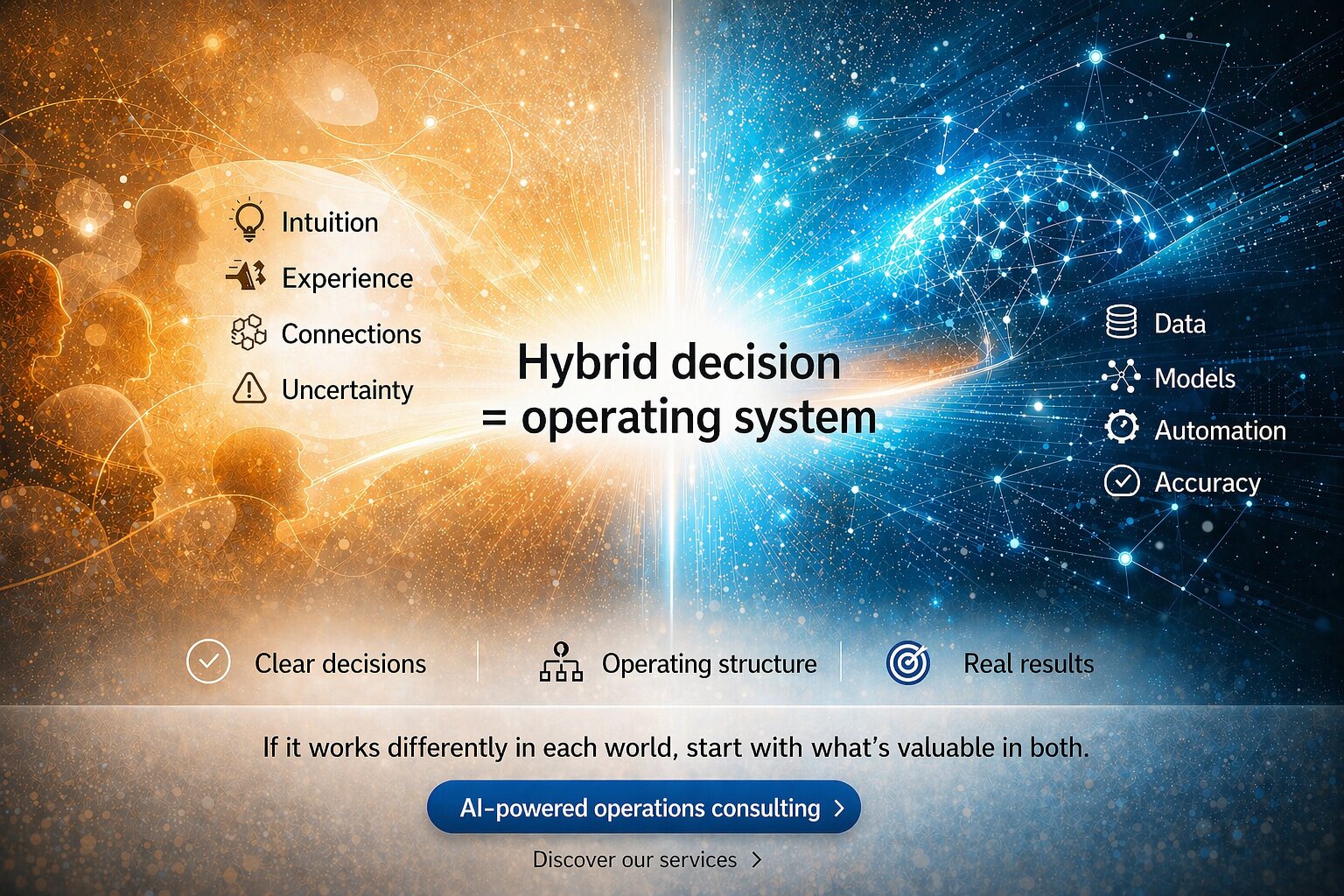
Many consultants look at a situation either purely from a business angle or purely from a human one. The essence of my work is that I don't separate the two. Behind every organisation there are people. Behind every individual stuck point there is a system. And behind every growth challenge there is always decision quality, clarity of responsibility and internal coherence.
That's why working together is at once strategic and personal, at once structural and creative, at once practical and deep. AI doesn't appear as a separate promise either – it takes its place where it genuinely accelerates and lightens what you're doing.
In practice, this means I help not only with making sense of a situation, but also with turning insights into real decisions, and decisions into lasting structures and measurable outcomes. This kind of work is most valuable when human sensitivity, strategic clarity and operational discipline are all needed at the same time.
Operations are not based on a single decision, but on an interconnected process
One key element of collaboration is ensuring that AI does not appear as a separate component, but is used where it creates real added value: organizing information, interpretation, decision preparation, implementation support, and feedback on results.
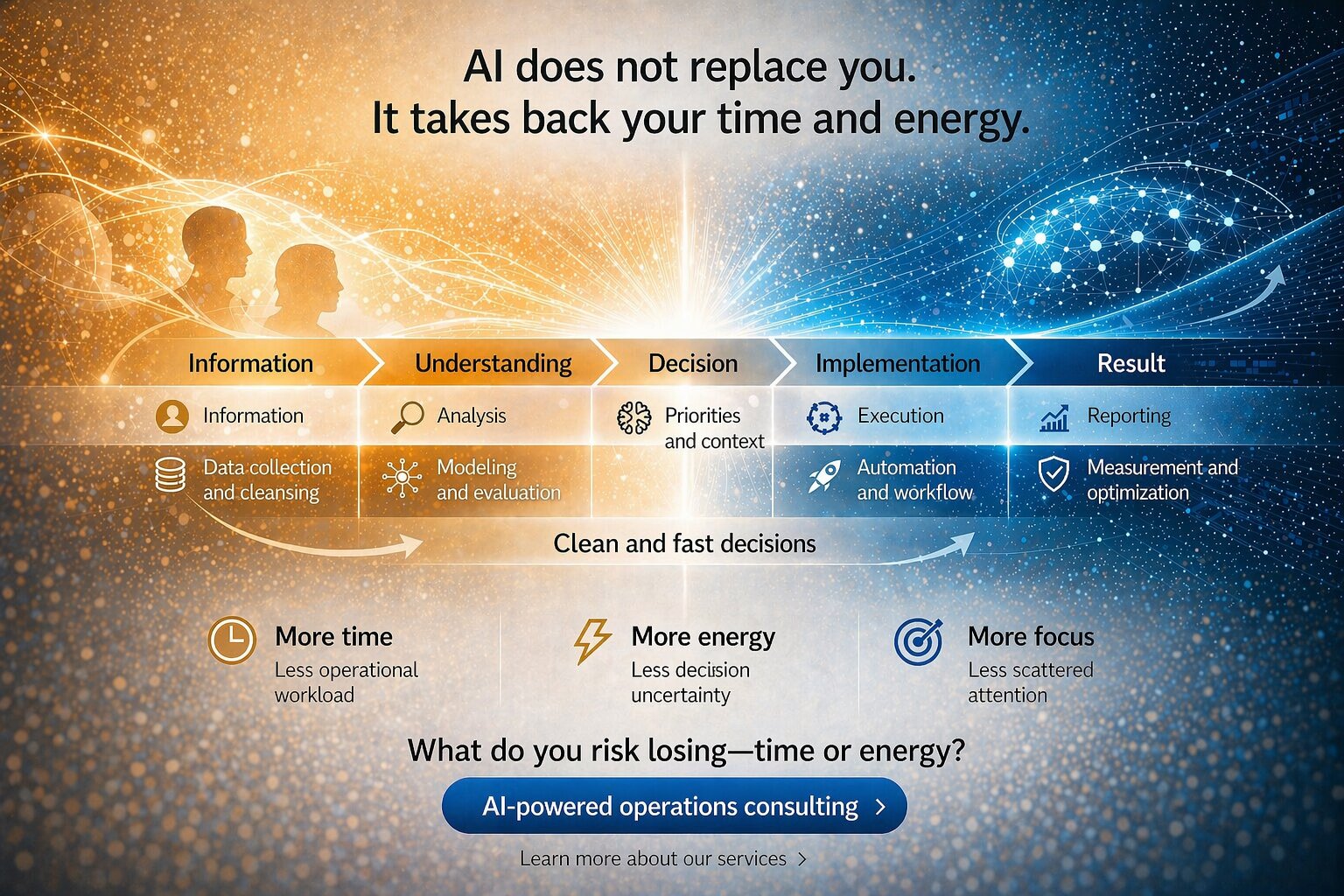
Information
Collecting, filtering, and separating relevant factors so that the essential becomes visible instead of noise.
Interpretation
Understanding patterns, relationships, and situations more accurately so that the decision space becomes clear instead of chaotic.
Decision
Aligning human factors, priorities, and AI-supported analysis to enable faster and clearer decisions.
Implementation
Creating automation, workflows, and operational solutions so that decisions become real actions rather than remaining theoretical.
Result
Measurement, feedback, and refinement so that the system becomes a sustainable advantage rather than a one-time solution.
More time
Less operational burden, fewer distractions, and more room for truly important leadership tasks.
More energy
Less decision fatigue, fewer unnecessary loops, and more internal capacity for real direction-setting.
Clearer focus
Less noise, fewer parallel attention losses, and more genuine direction within the organization and leadership work.
When is it worth reaching out to me?
If too many decisions are funneling through the leader
Fewer questions landing on one person, less leadership overload. Decisions are made where the most relevant information is available.
If the organization has grown, but the way it operates has not evolved with it
Fewer ad hoc solutions, less uncertainty. Processes and roles are better aligned with the organization’s current size and objectives.
If the team is working hard, but not in a sufficiently coordinated way
Fewer misunderstandings, less duplicated work. Greater transparency and alignment in achieving shared goals.
If AI is being used, but there is no real operational system behind it
Less fragmented tool usage, fewer inconsistent solutions. More consistency and greater business value from the day-to-day use of AI.
If a new business direction needs to be clarified
Less uncertainty, fewer conflicting ideas. Greater clarity around priorities and the next steps forward.
If there is plenty of energy in the organization, but little focused execution
Fewer scattered initiatives, fewer stalled tasks. More progress in the areas that truly generate results.
Not more ideas are needed, but clear structure
There are situations when the problem is not a lack of information, but the opening of too many directions at once. In such cases, what is needed is not more ideas, but clear structure, precise reflection, and decision anchors that create real movement.
With decades of experience in organizational development, HR, consulting, and human support, I work to help individuals, leaders, and businesses not only react to change, but actively shape it. Today, classical consulting is complemented with AI-supported systemic thinking: where needed, intelligent tools accelerate thinking, planning, content creation, and business development.
More than consulting
- organizational and HR background
- sociological perspective
- coaching and mentoring mindset
- change management experience
- AI-supported next-generation work methods
What results can be expected from collaboration?
Clearer situation awareness, more structured decision logic, less operational noise, and an operation where leadership time and energy can again focus on essential matters.
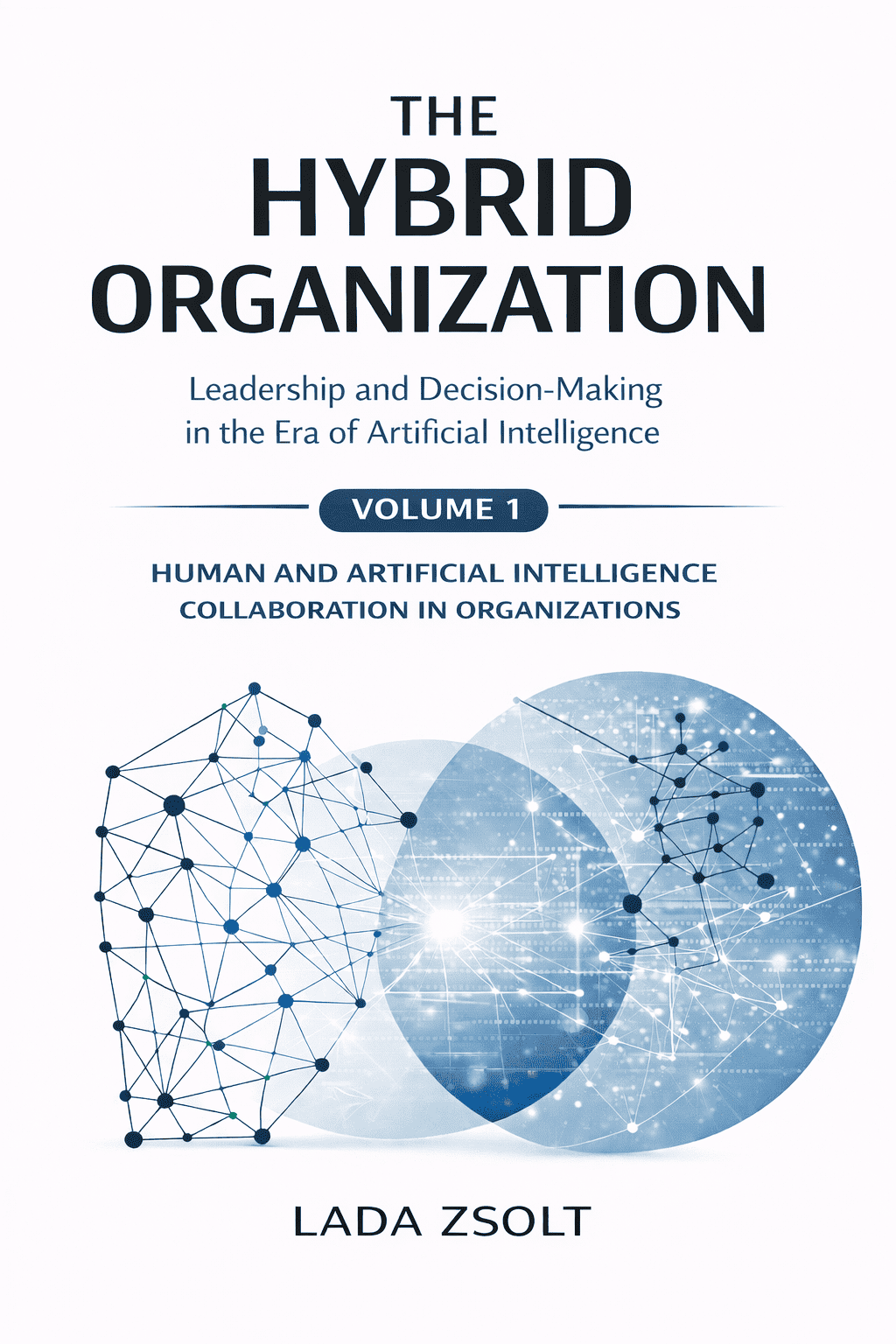
Hybrid Organization
Over the years, I have repeatedly experienced that questions about leadership and organizational functioning are never purely about systems or tools. Behind them are always people: their past, experiences, relationships, decisions, and losses. These shape us both as leaders and as individuals, and define how an organization truly functions.
I wrote the book titled Hybrid Organization because I increasingly encountered the question: how can leaders and organizations function effectively in a world where artificial intelligence is no longer an opportunity but an everyday reality. Today, the biggest challenge is no longer the lack of information, but how to interpret it, turn it into sound decisions, and ultimately transform it into operational systems that remain stable over the long term.
In the book, I share experiences developed over years of working together with leaders and organizations. I do not write about technological enthusiasm, but about how to create clearer structures, regain leadership time, and reduce the decision overload that defines the everyday life of many leaders.
If the next step requires not more work, but clearer operation
If you feel that the next step requires not simply more effort, but a different way of operating, then it is worth talking. Let us examine together where time and energy are currently being lost, and where collaboration can create real progress.